

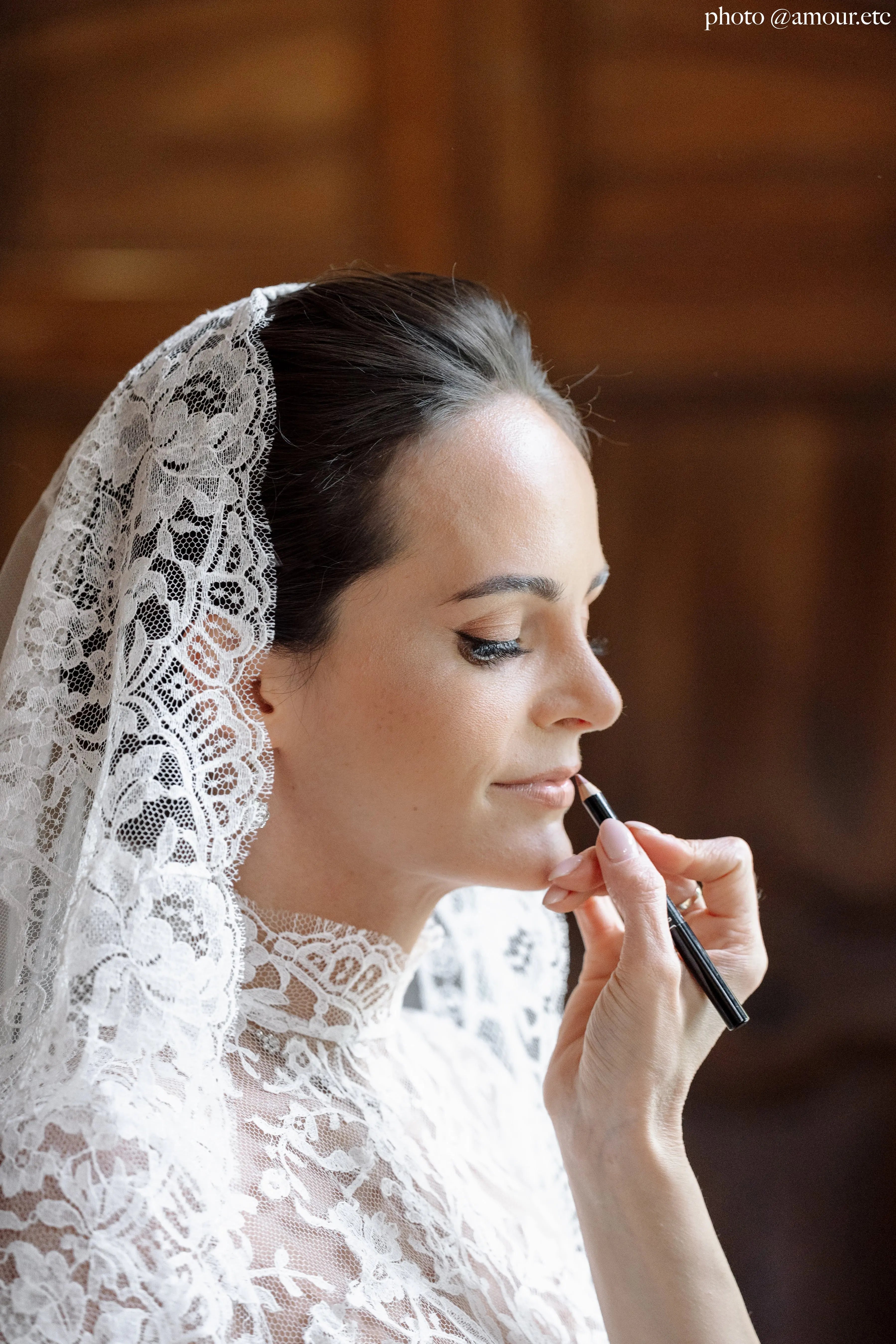


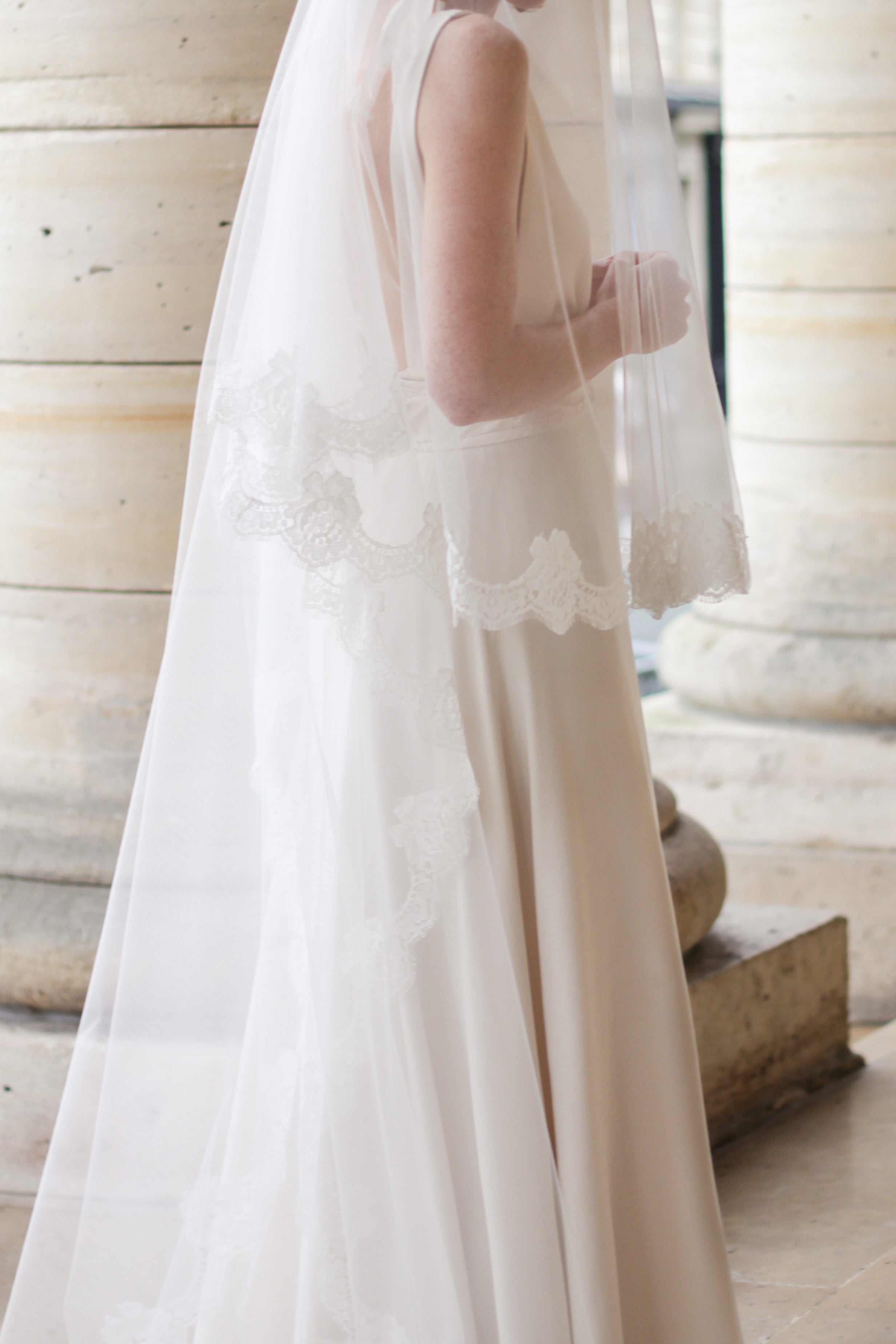
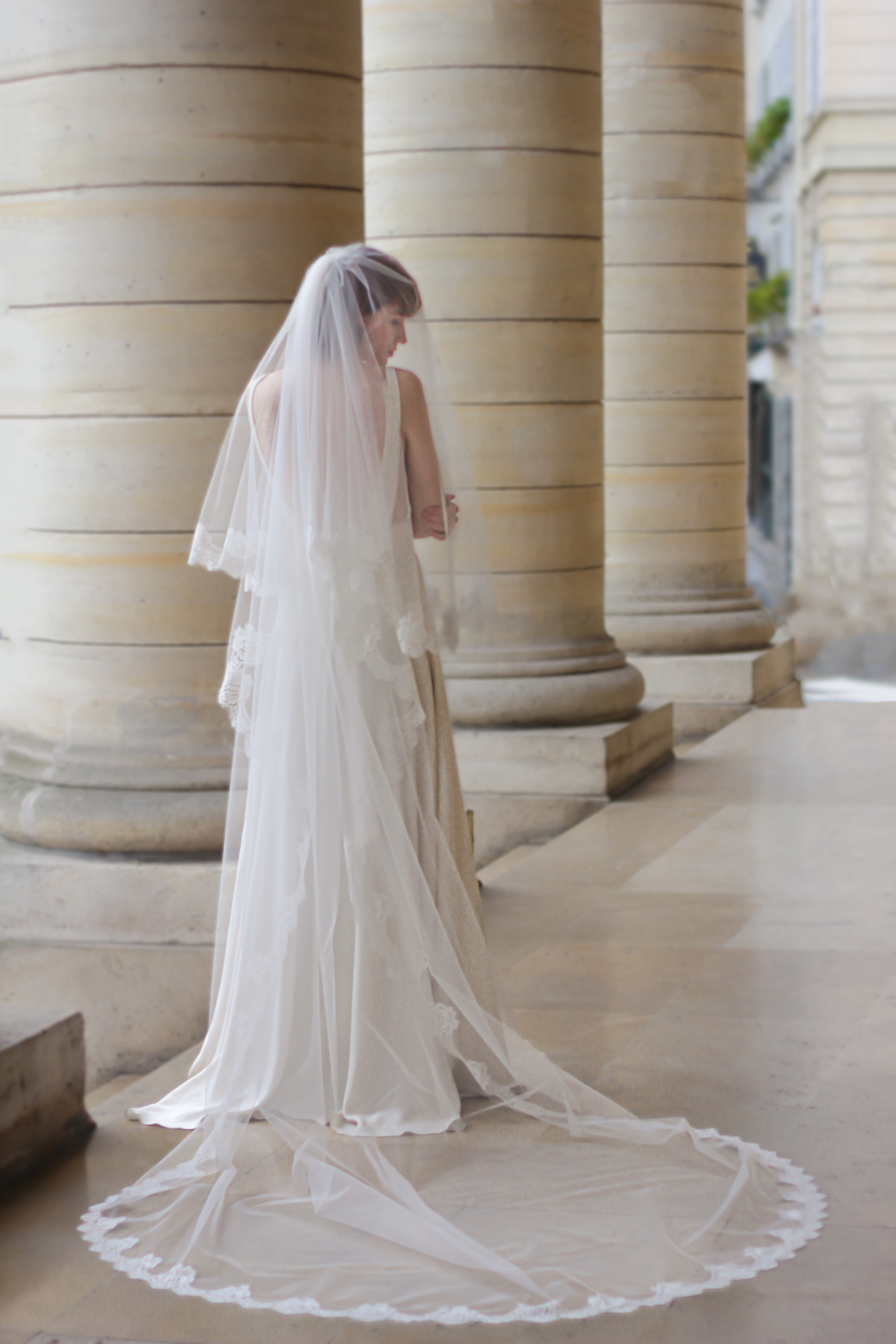
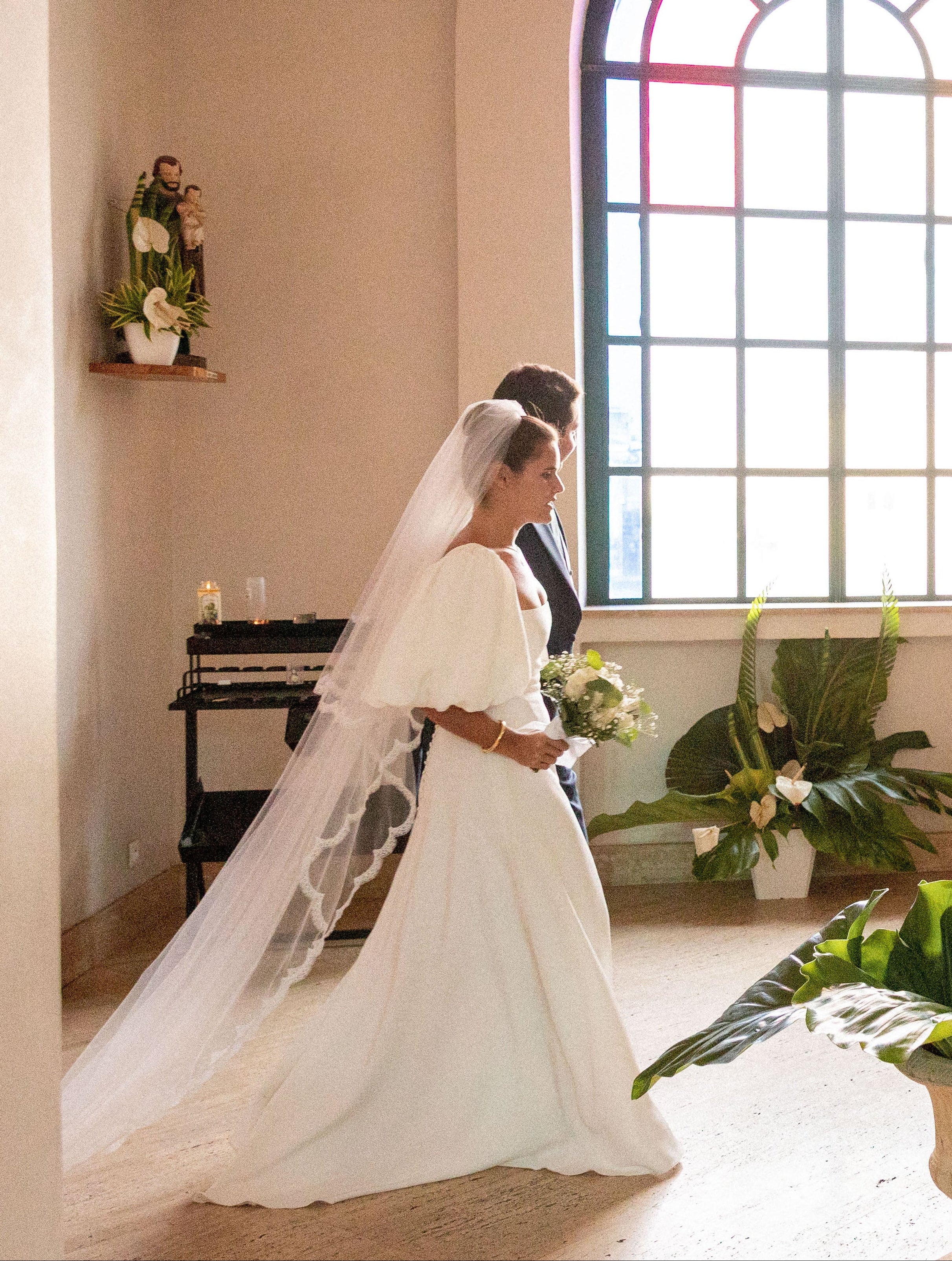
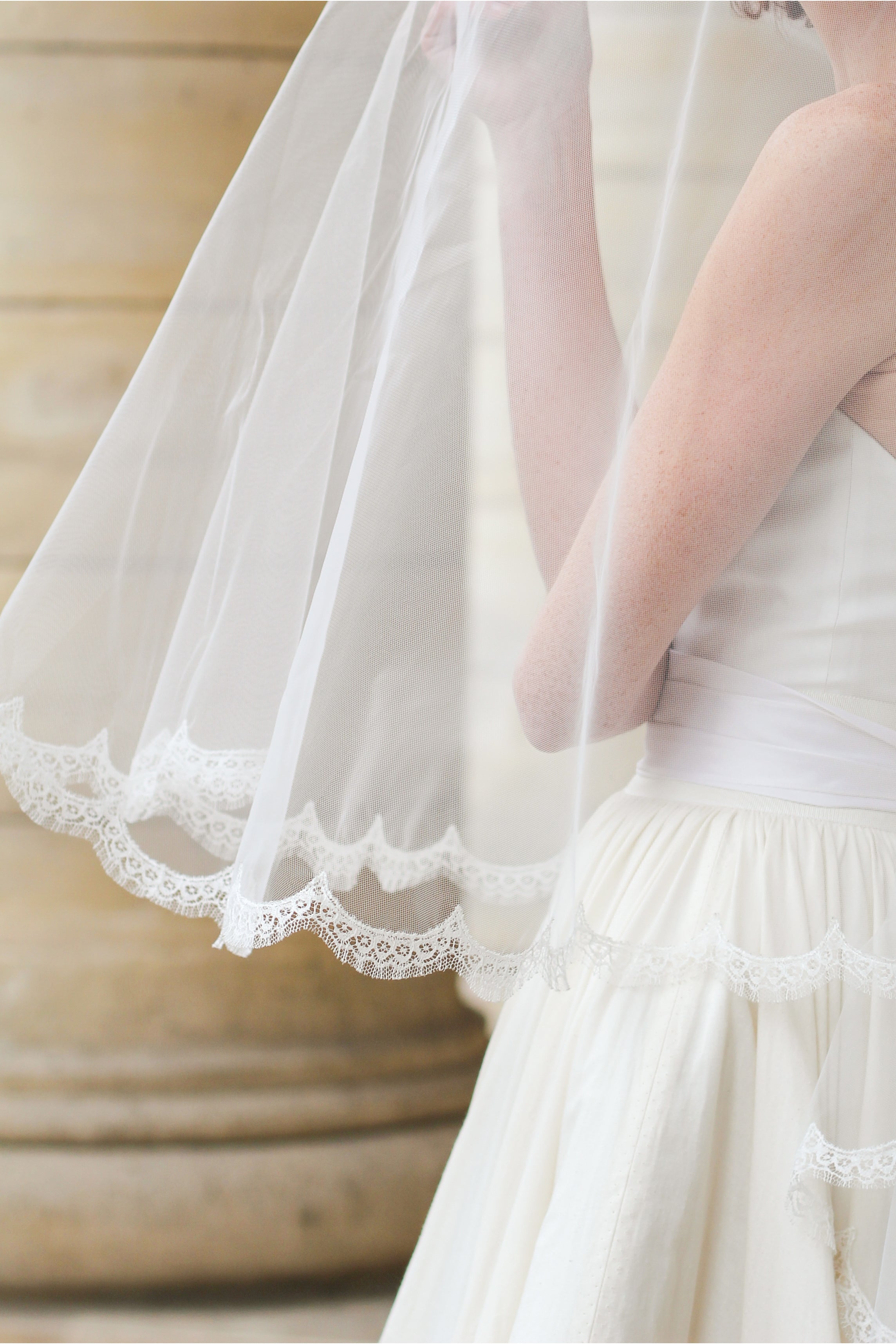


Many brides marrying in a Catholic church look for a veil that feels both reverent and personal. Our Catholic wedding veils bring together lace mantillas that frame the face and shoulders, cathedral veils that follow you the full length of the aisle, and softer tulle veils in chapel and cathedral lengths. Each one is finished by hand in our Paris atelier, in fine tulle edged with Calais-Caudry lace woven on Leavers looms. If you would like help choosing a length for your church, write to us and we will guide you.
Choosing a Veil for a Catholic Ceremony
The Catholic Church does not require a bride to wear a veil. Head covering in church was once part of canon law, but that rule was not carried into the current Code of Canon Law in 1983, and today the choice is a personal one. Many brides still wear a veil for a church wedding because it belongs to the long tradition of the sacrament, and because it gives the walk to the altar a sense of quiet ceremony.
Some parishes share their own guidance on bridal dress, from modest necklines to where the photographer may stand. It is always worth asking your priest or wedding coordinator before you choose, especially for a very long veil or a historic church.
A nuptial Mass also asks more of a veil than a short civil ceremony. You will stand, sit and kneel, sometimes for an hour or more. A veil that is light, well balanced on its comb and easy to arrange behind you will feel far more natural than a heavy one.
Mantilla Veils for a Church Wedding
The mantilla comes from Spain, where lace veils have been worn to church for centuries. For a wedding, it is cut in a soft circle and edged with lace all the way around, so the lace frames the face and falls over the shoulders in one continuous line. It is worn further forward on the head than a classic veil, which gives it its reverent, almost sculptural look.
Our lace mantilla veils, Avec Toi and Mon Amour, are cut to cathedral length in fine tulle and edged with Calais lace. They suit a simple crepe gown as well as a lace dress, since the veil adds a border rather than more pattern.
Lace Veils in Calais-Caudry Lace
Lace has a natural place in a church: it catches the light from high windows and reads beautifully in photographs taken from the back of the nave. Every lace wedding veil in this collection is edged with Calais-Caudry lace, woven in northern France on Leavers looms, then finished by hand in our Paris atelier. The lace sits only at the edge, so the tulle stays light and your gown remains visible beneath it.
If your dress is already heavily embellished, a scalloped edge or a narrow lace border keeps the look calm. With a plainer gown, a wider lace edge becomes the main detail.
Cathedral or Chapel Length: Which Suits Your Church?
The length of the aisle, the steps to the altar and the style of your gown matter more than any rule. Our guide to wedding veil lengths goes into more detail, but here is the short version.
Cathedral length
At about 138 inches (3.5 meters), a cathedral veil extends well beyond most trains. It is made for long aisles and large churches, where it has room to fall. Plan for a bridesmaid to arrange it when you reach the altar and again after you kneel.
Chapel length
A chapel-length veil, around 113 inches (2.9 meters) including the blusher, reaches just past the hem of the dress. It keeps the drama of a long veil while staying easier to manage on steps and in smaller churches. Our T'aimer tulle veil comes in both chapel and cathedral lengths.
The Blusher and the Unveiling
Several veils here include a blusher, a shorter layer worn over the face as you walk in. It is a tradition, not a liturgical requirement: some brides wear it down until they reach the altar, others lift it before the ceremony begins, and many leave it back from the start. If you are unsure who should lift it or when, our article on who lifts the veil at a wedding walks through the options.
Chapel Veils, Mass Veils and Your Wedding Veil
The term "chapel veil" can mean two different things. For a wedding, it describes a veil length. At Mass, it usually means a small lace mantilla or head covering that some Catholic women wear to pray. If you would like a veil you can keep wearing to Mass after your wedding, our Traditional Christian Veil in Silk is draped rather than pinned, made from pure silk georgette. You can read more about the practice in our guide to Catholic veils for Mass.
Made by Hand in Paris
Each piece is cut and finished by hand in our Paris atelier, then shipped to you with tracked delivery. If you have a specific church in mind, a gown already chosen or a question about length, write to us and we will help you choose.
Questions Brides Often Ask
Do Catholic brides have to wear a veil?
No. The Church does not require a veil for a wedding, and head covering has not been part of canon law since 1983. Many brides choose one as a personal expression of tradition. Some parishes have their own dress guidance, so it is worth asking yours.
What type of veil is appropriate for a Catholic wedding?
Any bridal veil is appropriate. Brides marrying in church often choose a longer veil, such as a mantilla or a cathedral or chapel-length veil, because it suits the aisle and the formality of a nuptial Mass.
Can a bride wear a mantilla for a Catholic wedding?
Yes. The mantilla is one of the most traditional choices for a church wedding. A bridal mantilla is usually longer than the small lace mantillas some women wear to Mass.
What is the difference between a wedding veil and a chapel veil?
A "chapel veil" can describe a wedding veil that falls just past the hem of the dress, or a small head covering worn at Mass. A wedding veil is longer, usually sheer tulle, and mounted on a comb.
Can I wear a cathedral veil in a Catholic church?
Yes, and a long aisle is where a cathedral veil looks its best. Check with your parish if the church has steps, a narrow aisle or photography rules, and ask someone to arrange the veil when you kneel.
Should I wear the blusher over my face during the ceremony?
It is your choice. The blusher is a tradition, not part of the liturgy. You can wear it down to the altar, lift it before the ceremony, or leave it back.
For the meaning and history behind the tradition, read our guide to the traditional Catholic wedding veil.
Discover our full wedding veil collection